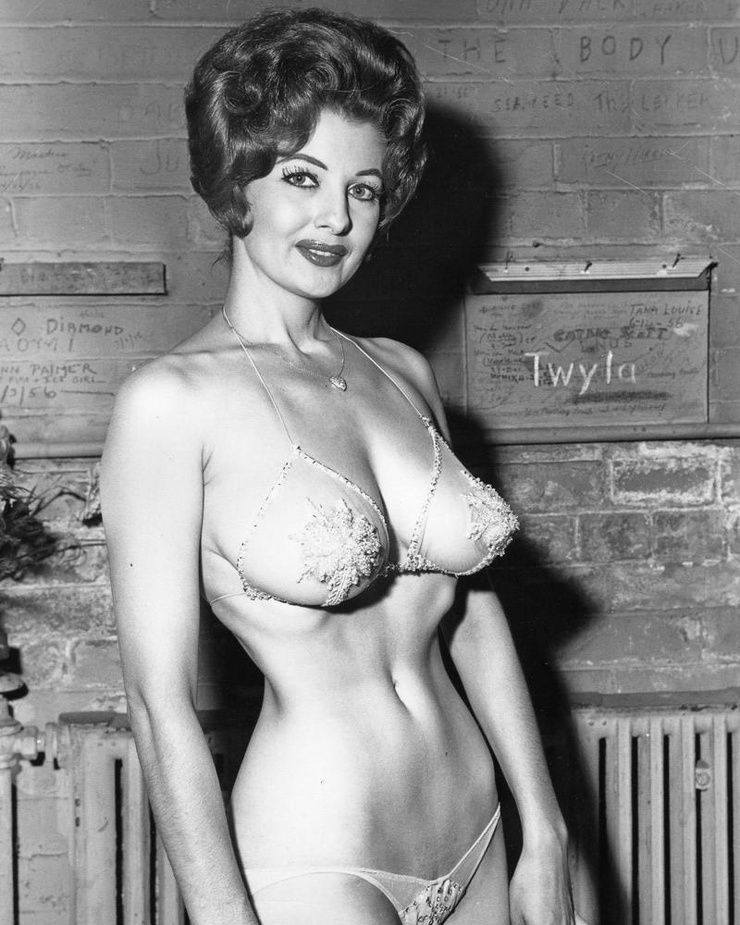
With a name like Tempest Storm, subtlety was never part of the equation. The persona promised spectacle, and she delivered it—night after night, decade after decade. With a mane of fiery red hair, commanding eyes, and an ambition that refused to be dimmed, the woman born Annie Blanche Banks would rise from a small Southern town to become one of burlesque’s most luminous and enduring figures. For more than half a century, she captivated audiences, not merely with glamour, but with presence—an artistry that elevated tease into theater.
She entered the world on February 29, 1928—Leap Day—in Eastman, Georgia, far removed from velvet curtains and glowing marquees. Her early life was marked not by glitter, but by hardship. At just fourteen, she ran away from poverty and abuse, propelled by a conviction that her future would not be confined to her circumstances. Two brief teenage marriages followed, chapters that closed as quickly as they began. What endured was her determination to reinvent herself. Eventually, she set her sights on Hollywood, drawn by the promise of transformation and the possibility of authorship over her own story.
From Cocktail Waitress to Headliner
The name that would define her career arrived in a moment of decision. A casting agent presented her with two options: Sunny Day or Tempest Storm. One suggested warmth and ease; the other, electricity and force. She chose the latter. Lightning, after all, leaves a mark.
Her early days in California were not immediately glamorous. She worked as a cocktail waitress, navigating smoky clubs and late-night crowds. It was during one of those shifts that a patron casually asked whether she performed striptease. The question lingered. Curious and undeterred, she gave it a try—and quickly discovered a rare gift. She could command a room with the slightest shift of her gaze, a measured pause, a deliberate turn of the shoulder. Her power lay not in what she revealed, but in what she withheld.
By the late 1940s, she was performing regularly. By the mid-1950s, Tempest Storm had become a bona fide headliner. Her act was defined less by provocation than by elegance. This was burlesque as choreography and suggestion—an intricate dance of glamour, humor, and suspense. She understood that anticipation was her most potent tool.
Her success was measurable in ways few entertainers of her era could claim. Lloyd’s of London famously insured her celebrated curves for $1 million, a staggering sum that underscored both her market value and cultural cachet. At the height of her career, she reportedly earned $100,000 annually—an extraordinary income in mid-20th-century America. The press, never one to miss an opportunity for wordplay, christened her “Tempest in a D-Cup,” a nickname that followed her through headlines and marquees alike.
Her cult status expanded beyond the stage. She appeared in films such as Teaserama and Buxom Beautease, sharing the screen with fellow icon Bettie Page. These productions, though modest by Hollywood standards, became staples of mid-century burlesque cinema and further cemented her reputation as a defining figure of the genre.
Discipline Behind the Daring Image
Onstage, she embodied daring sensuality. Offstage, she was disciplined to the point of austerity. Tempest Storm adhered to a strict personal regimen: no smoking, no alcohol stronger than 7-Up, and daily sauna sessions to maintain her physique and stamina. At a time when cosmetic enhancement was becoming increasingly common, she steadfastly refused plastic surgery, taking pride in her natural appearance and the discipline that sustained it.
Her popularity occasionally tipped into frenzy. In one memorable instance, a crowd of 1,500 students surged so aggressively to see her perform that the situation nearly turned into a stampede. Such episodes spoke not only to her allure, but to the cultural force she had become—an entertainer capable of igniting near-riotous enthusiasm.
Her personal life generated headlines of its own. She was romantically linked to figures including Elvis Presley and Mickey Rooney, associations that kept her name circulating far beyond burlesque circles. In 1959, she married the acclaimed jazz singer Herb Jeffries. Their interracial marriage was both controversial and courageous in an era still deeply divided by race. Together, they welcomed a daughter, Patricia Ann, adding another dimension to a life already lived in the spotlight.
A Career That Defied Time
What ultimately distinguished Tempest Storm was not merely her rise, but her longevity. While many performers fade as tastes shift and decades turn, she remained a fixture well into her eighties. Long after her contemporaries had retired, she continued to grace the stage, sustaining a direct connection to the art form she had helped shape. She was not a relic of burlesque’s golden age; she was one of its living architects.
Her contributions did not go unrecognized. San Francisco honored her with the declaration of “Tempest Storm Day,” a civic tribute to her cultural imprint. In 2016, her life and career were chronicled in a documentary that celebrated both her resilience and her unapologetic individuality, introducing her story to new generations.
When she died in Las Vegas in 2021 at the age of ninety-three, the curtain fell on a career that had spanned more than five decades. Yet her legacy extends far beyond sequins and spotlight. Tempest Storm embodied reinvention, self-possession, and the audacity to define success on her own terms. In an industry that often sought to confine women to narrow narratives, she authored her own—boldly, defiantly, and without apology.
In the end, the name proved prophetic. Tempest Storm was not a passing weather pattern. She was a force—electric, enduring, and impossible to ignore.
Be First to Comment