For most parents, running a hand through a child’s hair is an unconscious gesture—an absentminded sweep performed while reading a bedtime story or buckling a car seat. It is a tactile reassurance, a small ritual of connection. Usually, the fingers encounter nothing more than the harmless evidence of a day fully lived: a stubborn knot earned on the playground, a thin blade of grass from a backyard expedition, perhaps the faint grit of dried sand. These are the minor negotiations of caregiving, resolved easily with a comb and a quiet laugh.
But every so often, the hand pauses.
The fingers catch on something that does not shift under gentle pressure. It is not a tangle. Not a crumb. Not a forgotten sticker. It is firm. Anchored. Unfamiliar. In that instant, the ordinary fractures into alarm. The discovery of an unknown lump attached to a child’s scalp is not merely a medical concern—it is an emotional jolt. Confusion, urgency, and fear arrive in rapid succession, a visceral response that overrides reason.
Identifying the Intruder
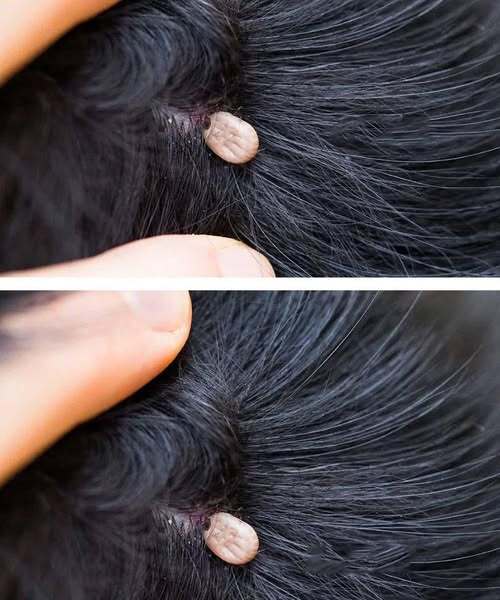
What many parents first notice is a small protrusion—often slate-gray or brown, slightly raised against the scalp. It does not resemble skin. It lacks the symmetry of a mole or the roughness of a scab. Its most disturbing quality is its resistance. Unlike dandruff or a loose hair, it does not brush away. When touched, it holds fast.
The realization follows quickly: this is not debris. It is a tick.
Ticks are arachnids, distant relatives of spiders, sustained by blood. In their nymph stage, they can be extraordinarily small—no larger than a poppy seed, measuring roughly one to two millimeters. Their anatomy is designed for stealth. Equipped with barbed mouthparts engineered to anchor securely into skin, they can remain attached for days without detection.
The scalp is prime territory. Hair provides both warmth and concealment, creating a sheltered environment ideal for feeding. Children, who spend hours weaving through tall grass, rolling across lawns, or exploring wooded edges of parks, are particularly susceptible. To a tick, a child at play is an opportunity.
The Biology of Deception: A Physical Transformation
One of the most unsettling aspects of a tick encounter is its transformation over time. What begins as a tiny, nearly invisible speck can gradually swell as it feeds, expanding into a rounded, pebble-like form. To an untrained eye, an engorged tick may resemble a wart or a small growth rather than an insect.
This evolution is not accidental; it is biological strategy. Tick saliva contains anticoagulants that prevent blood from clotting and anesthetic compounds that dull sensation at the bite site. The result is a parasitic efficiency that allows the tick to feed undisturbed. By the time a caregiver detects the bump, it may have been present for several days—lengthening the window during which certain tick-borne illnesses could potentially be transmitted.
The Emotional Toll: Fear and the “Safety Myth”
Beyond the clinical implications lies a powerful emotional response. The discovery often triggers a wave of parental guilt. Questions flood in: How long has it been there? Did I check thoroughly enough after the park? Was there a sign I missed?
Concerns about illnesses such as Lyme disease or Rocky Mountain spotted fever add a layer of legitimate medical anxiety. Yet beneath that is something more primal—the visceral discomfort of realizing that a parasite has been feeding unnoticed. It punctures the comforting illusion that familiar environments—a backyard, a local trail, even a well-kept park—are inherently risk-free.
In the aftermath, many parents enter a period of heightened vigilance. Hair checks become more methodical. Outdoor routines shift subtly. What was once a carefree tumble in the grass now carries a new layer of scrutiny.
The Clinical Response: Precision Over Panic
When a tick is identified, the immediate task is to replace panic with procedure. Improvised or forceful removal—crushing the tick, twisting it aggressively, or attempting to burn it off—can complicate matters. Such actions risk leaving mouthparts embedded in the skin or increasing the possibility of pathogen transmission.
The widely accepted protocol is straightforward:
-
The Tool: Use fine-tipped tweezers.
-
The Technique: Grasp the tick as close to the skin’s surface as possible, targeting the head rather than the body.
-
The Motion: Pull upward with steady, even pressure. Avoid twisting or jerking.
-
The Aftercare: Clean the bite area thoroughly with soap and water or an appropriate antiseptic.
In many regions, preserving the tick in a sealed container can be helpful. A healthcare provider may use it to identify the species, offering guidance on potential risk and whether follow-up care or monitoring is advisable.
Prevention as Empowerment
For many families, the first encounter with a tick is deeply unsettling. Yet it often becomes a turning point—less a retreat from the outdoors and more a recalibration of how to navigate it safely.
Prevention shifts from abstract advice to practical routine. Protective measures include using Environmental Protection Agency–approved repellents containing ingredients such as DEET or picaridin. Dressing children in light-colored clothing can make ticks easier to spot before they attach. Managing outdoor spaces—keeping grass trimmed, clearing brush, and creating defined play areas—can reduce exposure risk in home environments.
The goal is not to eliminate nature from childhood, but to engage with it intelligently.
The Broader Lesson: Coexisting with the Quiet Intruders
The presence of ticks serves as a sobering reminder that even in an age of climate control and suburban order, human lives remain intertwined with complex ecosystems. Parks, backyards, and wooded trails are not curated stages; they are living environments with their own hierarchies and hazards.
While the initial shock of discovering a tick on a child can feel overwhelming, most families eventually find that the episode evolves into something more instructive than traumatic. Fear softens into awareness. Hyper-vigilance matures into informed habit.
In time, the panic sparked by a “strange lump” gives way to measured confidence. Parents learn the signs. They master the removal technique. They adjust routines without surrendering the freedoms of outdoor play.
The lesson is not one of retreat, but of coexistence. With knowledge and steady action, caregivers reclaim control—not by eliminating risk entirely, but by meeting it with preparation and calm resolve.
Be First to Comment